
Why (And How) You Should Prune Your Trees
Some types of yard work are simple. Mowing your grass? Set the height of your mower and avoid mowing in wet conditions and you’re just about guaranteed to do it right. However, this is not the case for every outdoor task – and tree pruning is both very important and can easily be done wrong by enthusiastic homeowners or uninformed landscaping crews.
Today we’re going to look at the reasons why you should prune your trees and offer some basic guidance on how to prune small trees. Have bigger trees that need pruning? The best solution is to work with an International Society of Arboriculture (ISA) certified arborist, as they have the tools and training to ensure your trees remain healthy and beautiful for decades to come!
Why Prune Your Trees: The Benefits of Tree Pruning
Tree pruning is like a hair cut with health benefits. Not only will pruning let you take control of the size and shape of the tree, but it also can help prevent tree diseases.
These are the most common benefits of tree pruning:
Encourage Healthy Trees
Dead, damaged, or diseased branches not only look bad – but can jeopardize the health of the tree. Removal of these damaged tissues helps prevent problems from spreading or worsening.
Prevent Crowding or Rubbing
In some cases trees grow in a way that will eventually cause damage to themselves, limit air circulation, or even encourage aphids. Removing branches with narrow crotch angles or branches which rub against others can prevent future problems.
Encourage Flowering & Fruit Production
Removing old flowers, a practice known as dead-heading, helps prevent flowering trees from spending valuable resources on seed production. This, in turn, leads to more buds being set in the next fruiting season. Pruning also can be used to encourage fruit trees to produce fewer, but more developed fruit.
Maintain Size or Shape
Sometimes the reason for pruning is as simple as keeping your tree the right size or maintaining a tree’s structure. Hedges and espaliers need occasional touch-ups, and in tight spaces a tree may need pruning to prevent it from crowding or shading out its neighbors.
Keep Old Plants Looking Young
Certain shrubs may require pruning to stay looking young. By cutting back old growth you can restore these plants youthful vigor and shape.
Mitigate Risk
Sometimes trees need to be pruned to avoid power lines and buildings, maintain sight lines near roadways, and prevent falling limbs from posing risk to people and property.

How to Prune Trees: The Tools of the Trade
Just like a hair cut done with kitchen shears is never going to look as nice as one done with a barber’s precision hair scissors, pruning works best when you use the right tool for the job.
Thankfully for homeowners looking to maintain smaller trees and shrubs, there are relatively few tools needed (and a few to avoid):
Hand Clippers
The workhorse of small pruning jobs, hand clippers are suitable for branches smaller than a half-inch in diameter. We recommend bypass clippers over anvil-style clippers, because they provide cleaner cuts, although they may not be suitable for larger diameter branches.
Lopers
These longer pruning tools provide more leverage and are good for cuts up to 1.5-inches in diameter.
Pruning Saws
For pruning thicker limbs (1.5-inches or greater) a pruning saw can’t be beat. These curved saws are typically 12 to 15-inches long and generally only cut on the pulling stroke for greater control.
Pole Pruners
Essentially just lopers mounted atop a 10 to 12 foot pole – these allow you to cut branches out of arm’s reach.
Note: Use pole pruners with extreme caution around power lines.
Avoid: Hedge Shears
Unless you intend on creating a very artificial end product like a topiary, hedge shears are almost always the wrong tool for the job. We recommend homeowners avoid this tool unless they know what they are doing and want to forgo a natural shape!
Avoid: Chain Saws
Powerful, imprecise, and dangerous, chainsaws are not suitable tools for pruning. If your pruning project requires you to cut limbs thick enough that a chainsaw seems like the only viable option, please consult with an arborist before making any cuts!

How to Prune Your Trees: When to Prune
A common pruning mistake we see is not taking into consideration seasonal growth patterns of trees and shrubs.
It is held as a general rule that ornamental shrubs “that flower before June 1 should be pruned after they bloom” and plants that “flower after June 1… can be pruned just prior to spring growth.”
Now, before you take this ‘general rule’ as gospel, note that there are many factors which govern the ideal time to prune. Take for example certain trees like maple, birch, dogwood, beech, and elm – these species will bleed ample amounts of sap if cut while their leaves are developing. While this isn’t dangerous to the plant, it is unsightly and often attracts stinging insects. For these plants it is best to wait until their leaves are fully formed.
It is important to know the proper pruning time for your plants before embarking on a DIY plant-haircut adventure. Local, ISA-certified arborists often offer consultation services and will be able to offer guidance so you can safely maintain your yard.
How to Prune Your Trees: Where to Cut
Perhaps even more important than when to cut is where to cut. Unfortunately, we have seen many beautiful trees irreversibly damaged by enthusiastic, yet uninformed pruning decisions.
The short answer:
In general, it is a good idea to cut off diseased, damaged, or dead branches. Branches which rub against one another, lower branches which descend downward from limbs, or are growing from the main trunk at narrower than a 45 degree vertical angle are also good candidates for removal. Avoid leaving a stub behind as this may delay healing time and promote disease.
The long answer:
Deciding where to prune requires taking many factors into consideration. Ultimately, the goal of pruning is to create a healthy, visually appealing branch structure – but what this entails varies by species.
While giving a general answer is difficult, understanding the tree growth mechanism known as apical dominance will help you in deciding where to make pruning cuts:
In both evergreen and deciduous trees, apical dominance refers to plants relying on a hormone called auxin to control the growth of lateral buds (the buds which emerge from the sides of a branch). Auxin is produced in terminal buds, or the bud which is furthest from the trunk. If the terminal bud is removed, then auxin levels fall and more growth will be directed towards lateral buds and sprouts.
What this means is that if a branch is cut at the tip, then you should expect the buds nearest it to develop more growth. Cutting lateral branches or buds doesn’t change auxin levels and so doesn’t encourage the same increase in new growth.
Unfortunately, this apical dominance varies by species, and may even vary within a species based on the growth season. Young trees and older trees also may have different pruning needs – making it hard to offer useful generalizations.
For this reason it is generally recommended to work with an ISA-certified arborist on large pruning projects. For DIY projects, be sure to find out how your particular tree or shrub will respond to pruning cuts before deciding on your cut location.
How to Prune Your Trees: Making the Cut
Finally, now that we have a better idea of when to cut, and where to cut, it is time to address how to cut.
The most basic takeaway here is that you should attempt to cut in a way that does the least amount of damage to the tree. Crushing, bending, or ripping all should be avoided. Clean cuts are the goal. For lopers and hand clippers, try to complete each cut in one smooth motion.
If you are pruning to remove diseased branches, be sure to disinfect your cutting equipment between cuts using either a 10% bleach and water solution or disinfectant alcohol.
Top Pruning Mistakes To Avoid
Mistake #1: Hat-Racking
This involves cutting all branches back to an arbitrary length – producing the ‘hat-rack’ look that it is named for. Please, do not do this to any tree you want to live. This is not a pruning technique and is highly likely to kill or permanently disfigure your tree.
Mistake #2: Tree Topping / Crape-Murder
This is often seen used for trees underneath power lines or near homes and involves cutting the leader, and possibly some main branches, of your tree. The topping method will shorten the life of your tree and cause problematic growth patterns with weak and unattractive growth emerging from the top cut.
One common example of tree topping that isn’t related to power lines is Crape-Murder. Crape myrtles are a frequent victim of topping and the resulting mess is hard to look at and harder to recover from.
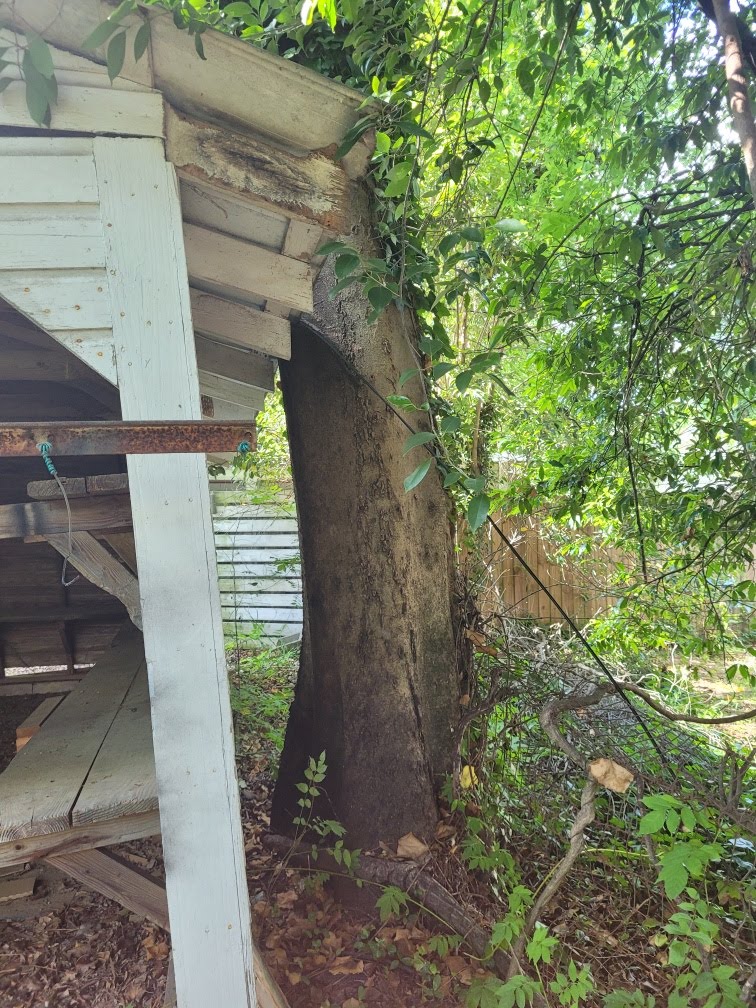
Mistake #3: Removing Branch Collar Bark
When pruning large branches from the main trunk it is important to not remove any of the branch collar bark. This area can be recognized as the slightly swollen area at the base of a branch and must be left intact for the tree to properly heal after a pruning cut.
Mistake #4: Having a Landscaper Handle Your Tree Services
While there very well may be a landscaping company that has ISA-certified arborists on staff, there is nothing stopping them from offering tree trimming services even if they do not! And, from what we’ve seen over the years, most do not.
Unfortunately, many homeowners in the Midlands have lost beautiful mature trees to landscapers who did not know the first thing about tree care.
How to Prune Your Trees: When to Call the Pros
Pruning trees and cutting grass are superficially similar, but the reality is that pruning is a complex subject and there is no one-size-fits-all answer to the question “How do I prune my tree.” Ultimately the answer is going to depend on many factors including the species of the tree, the time of year, your goals, and how each branch is situated.
If you have one or two small trees which need pruning then it may be worthwhile to take the time to research all of these variables and come up with an educated plan. However, for larger pruning projects, or for any tree which you do not feel comfortable pruning due to size or complexity, it is time to contact an ISA-certified arborist.